Wednesday, June 23, 2010
Greenslate inspires teachers

Six weeks until Wednesday
The Walter Cronkite School of Journalism and Mass Communication at Arizona State in Phoenix was home for amost 12 hours a day for the past 2 weeks to 34 journalism teachers from around the country. (Photo by Jodie Schommer)
As the week winds down, the temperatures ramp up. The 2010 ASNE Reynolds Institute Fellows prepare to say farewell to new found colleagues and the beautiful Arizona State Campus. (Photo by Jodie Schommer)
Well all, have you figured out the theme of the titles of my blogs yet this week? I have learned so much and it has all come together and clarity has hit. I have a clear direction after the presenters of today and yesterday. Alan Weintraut's various web sites lit a fire under me. (Too bad his emails went into my spam folder-thanks for resending).
Five things, implement 5 things every year and think about the changes in your publication in three years. Wow! Unbelieveable. This whole week has been amazing.
I always start every class with a 5-8 minute warm up. I use a variety of "fun" things. Try out www.freerice.com -it's a great interactive way to learn vocabulary AND companies donate rice to the hungry of the world.
I did 2 new things today-sent a picture over my phone and made a link in this blog. I'm riding the learning curve up and the ride is great.
Jodie Schommer
Lakeside Lutheran High School
Lake Mills, WI
Students thrive in team atmosphere

Reynolds Institute Movie Night

Assignment: Cover the baseball game
Nicki Yokota
St. Margaret's Episcopal School
San Juan Capistrano, CA
Take me out to the ballgame

What a great time we had tonight. After a day of deadlines, it was good to get away and enjoy some fun.
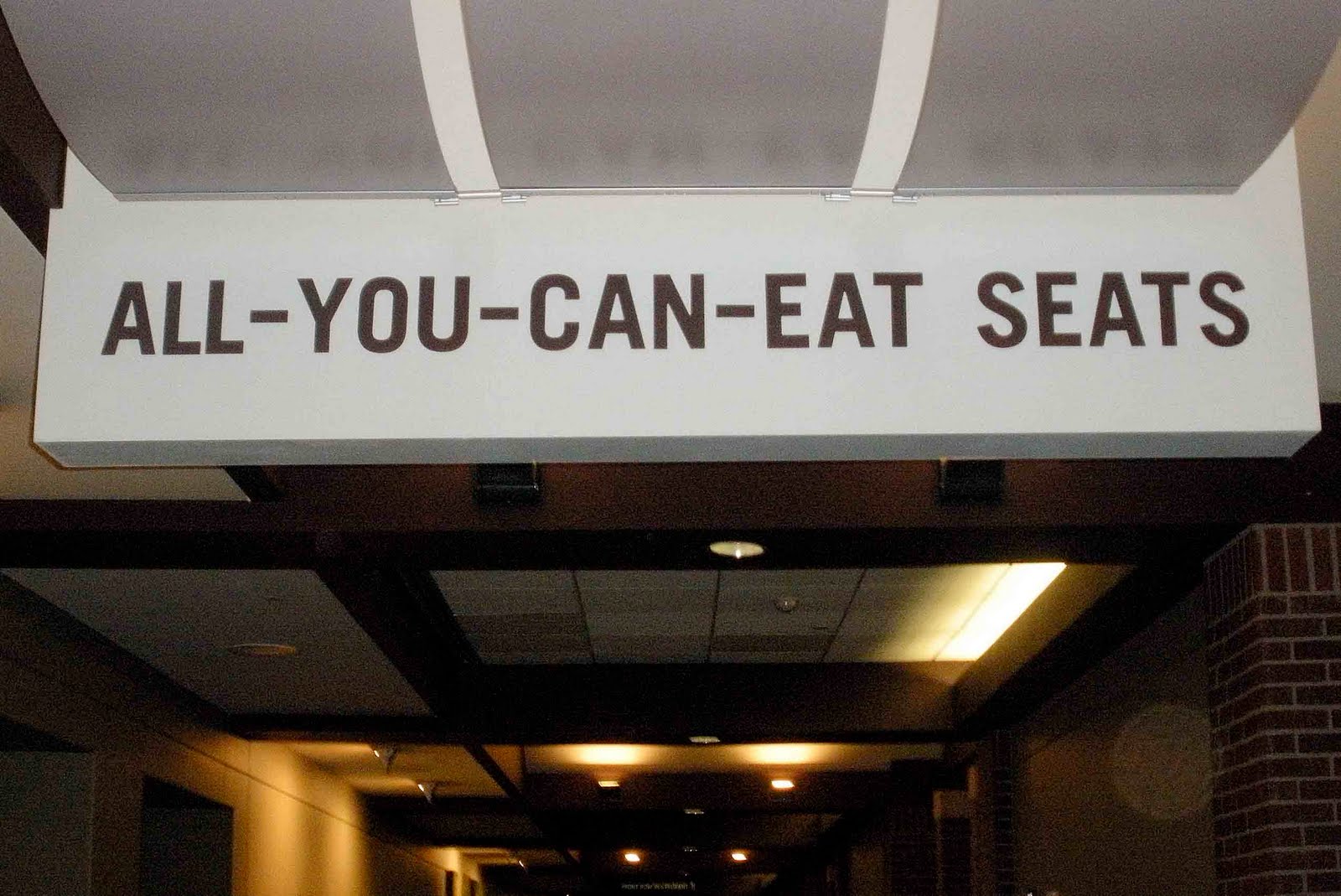
I am not a baseball fan, but the atmosphere of the crowd and sounds fills your attention to where it was easy to relax and let loose. The all-you-can eat seats did help as well.
Thanks to the Anita, Steve and the Reynolds Institute for everything. This was a great learning experience, and I am ready to begin a new year more excited than ever before.
Leona O'Neal
George County High
Lucedale, Miss.
Color wheel continued
Kim Vinh mentioned ways that Twitter and Facebook could be useful for high school journalists, and I'm curious what others of you think about incorporating social media into your classrooms.
Jamalee Moret
Alhambra High School
Phoenix
The color wheel of social media

The spectrum of colors in this demonstration represent the many different social networks.
Some of which are:
- Blogger
- My Space
Here is a cheat sheet to help you navigate the social media world.
I am still learning how to navigate them myself. Photo by Bracinda Blum of Carol Schwalbe, Associate Professor of the Walter Conkite School of Journalism and Mass Communication talking to the ASNE Reynolds Institution participants today about social media.
What do you think about using social media as a way of communication?
Bracinda Blum
Woodbine High School
Woodbine, Iowa
A case for Twitter
I wanted to offer an argument for Twitter as a valuable tool for journalists, as many today seemed unconvinced of its worth. As the Twouble with Twitter video said, there are clearly a lot of people tweeting about mundane details of their day: what they ate, how hot it is, blah blah blah. I was definitely unconvinced by Twitter at first as well. But as a tool to show students how many are paying attention to important events, I've been very surprised and have found ways for my journalists to use Twitter.
How this came about: I was multitasking while watching the most recent State of the Union, and with Twitter open, I noticed that the number of comments on the speech was out of control: over 300 comments were being posted (I suppose I should say “tweeted”) a minute. Three hundred comments a minute! By the end of the speech, there were hundreds of thousands of comments. Many were funny, some were unnecessary, but several were very insightful. A lot linked to reports or articles about events or data mentioned – stuff I would want to look up on my own – much like Jason Manning’s demonstration of the "one screen" News 21 Initiative news packages. Even some congressmen in attendance were tweeting (which raised controversy), and it was interesting to read their real-time reactions.
The next day at school, I asked my students if they had watched. At least ten of them said they did only because they started seeing everyone on Facebook and Twitter posting about it. A few didn’t even know it was on until checking Facebook; the others said they felt like they should turn on the tv since so many people were talking about it.
In short, checking Facebook led my students to watching the State of the Union. Not bad, I thought. This could be useful after all.
Now my students spend the first day of our production cycle coming up with story ideas. One resource they check is Twitter. Which hashtags are popular, and then local and interesting to us? What major events are people talking about?
Len Downie Jr. told us to “not condemn the silly things on Facebook. Use it for the important things.” The same goes for Twitter.
Right now I follow my favorite writers, professors, and political figures. I delete people who don't give me anything useful. You don’t need to post anything yourself if you don’t want—I definitely don’t try to add to the nonsense. But I check it frequently and encourage my students to as well.
Just don’t call me a tweep.
Kim Vinh
Sequoia High School
Redwood City, Calif.
Some more links:
A journalist’s guide to Twitter
Six ways to make Twitter useful
Manning the Way into the future of Journalism

To end our ninth day we looked to the future with Jason Manning, ASU Student Media Director. He was really big on looking into strategies to direct the use of technology tactics. One thing that directs our media consumption habits is the segmenting of media so that we "only consume what we like."
In order to counter this situation we need to develop greater media literacy so we can become critical consumers. This will allow consumers to decide if they need to hunt around for better or different news. That information is being shared and exchanged on social networks with then react with media sources. The pace of exchange is speeding up, said Manning.
Social media channels used to be verboten in legacy news organizations, but they are fully accepted now.
We then really headed into the future: 3-D web, holograms, programs finding you on the web, and the need for teaching social media to our students to make good decisions.
JH Appel
Chaparral HS
Chaparral, NM
History Through Your Eyes
I appreciated his perspective about how either the "news media was unprepared; they missed the story, the unrest, or they just didn't care." It became clearer when he went into his own story about how he became interested in journalism and the importance of diversity. Diversity is not just about color, but different perspectives presented in different ways.
He spoke of how people look to the news "to affirm their own views." That is perhaps why there is such an issue with diversity - when the news is presented from a different, fresh, more accurate perspective, people won't always hear what they want to hear; they'll probably be getting more of the truth...as much as it hurts sometimes, said Jenese.
Jenese Giles
Northeast High School
Oakland Park, Fla.
Conversations we never want to have


Elaine's to do list
Twifferic twession twoday!
The two sessions this morning were all about technology and how to use it not only in the classroom but for your own personal use, which was nice to discover. Our stories are due

I haven't been this anxious about an assignment in a long time. The majority of us have been frantically gathering data, conducting interviews and editing these stories for over a week now. Yesterday's editing session confirmed my lack of journalistic writing style. I have a lot to learn and little time to learn it. At least I have all the resources I could ever want to help me teach my newspaper class.
Tweet, Tweet...

Feeling a little overwhelmed right now. Carol Schwalbe, Associate Professor at the Cronkite School (left), gave a comprehensive overview of all the social media options we have at our fingertips, and I have to say that that I’m feeling swamped by all the possibilities out there. While she was speaking, I googled (Googled?) “social media cheat sheet” and in one link I viewed, more than half of the programs listed were brand new to me. Yikes. I’d better get busy and start investigating and experimenting. I’ve already signed up for Delicious (thanks, Meghan, for that nudge!), an organizational tool I’d heard about before but tucked away into that deep bin where good ideas sometimes go…and never emerge.
About Twitter – I’m still not sold on its benefits. Schwalbe calls is a powerful “listening tool,” but I’m not sure I want to hear all that all the time. Maybe I’m missing something, but I’m willing to be convinced. I think I’m going to check out TweetDeck (because it seems like a good visual tool to keep me sane over this new thing…) and try to follow a few people, like John Stewart, Nicholas Kristoff (NY Times columnist) and Leonard Pitts (Miami Herald). Now to come up with a cute Tweet name…
Leslie Wolfe-Cundiff
Centennial H.S.
Roswell, Ga.
Deadline stress
This caused everyone stress, but it has been good to feel that pressure and get me writing again.
Even though I'm apprehensive about the upcoming edits, I am excited that I'm writing again. And there is a feeling of accomplishment at putting together a piece that is researched and well thought out and will be published!
Meghan Brannon-Reese
Houston, TX
Serious Swag
I am not a huge sports fan, but I have been looking forward to the game this evening ever since I was accepted to the program. I am surprised that there won't be some lesson on sport journalism. Speaking with others the feeling of overload is mutual and the game this evening will be a nice break. The hats given to us are awesome! Reno is the home of the D-Backs' triple-A team the Aces. So, though I love my new hat, I will be wearing my Aces one.
As a teacher, we rarely get many benefits, so the experience these past two weeks have been astonishing: the information has been extremely pertinent and applicable, the accommodations impeccable, the fellowship humbling.
Ryan Ludwig
Spanish Springs H.S.
Sparks/Reno, Nev
Social Media Cheat Sheet
Here is the social media cheat sheet requested by Bracinda. It is from a marketing point of view, but it seems to be pretty informative and useful for several different areas. Here is a link to the site: cheat sheet site
Kim IsbellNo Excuses
I am inspired, once I return home, to continue to work on this map and detail out my plans for implementing enough change so that when school opens, I am ready to lead my staff to a whole new level of writing and production. It's exciting and challenging but, because of this presentation, entirely doable.
Nicki Yokota
St. Margaret's Episcopal School
San Juan Capistrano
A visit to Pity City
Rodriguez: Diversity need not always reference race
Rick Rodriguez, former editor-in-chief of the Sacramento Bee, is no exception to that rule. In fact, he said his high school years were so formative that they continue to inform his job now, working with the Southwest Borderlands Initiative.
He especially enjoyed his journalism teachers diligence and ability to reach out to students who show potential.
"Art Gallago was a task master," Rodriguez said. "But he really cared for his students."
Rodriguez is now modeling that role of task master and talked about how he had to push one of his best students to actually get out to the border between Arizona and Mexico and see for herself what his happening.
"When she came back," he said. "She came back weeping."
For me, diversity coverage in our publications is probably the diciest, most rewarding aspect of my classroom. It is never easy to push kids out the door, hoping they will come back with quotes and information from somebody they have never met before.
Image of Rick Rodriguez courtesy of Nicki Yokota.
Nate Thompson
Montezuma-Cortez High School
Corte, Colo.
High stakes
I loved the honest and sometimes brutal criticism Brian gave. He wasn’t mincing words: “this is wacky,” “this doesn’t do anything for me.” Yet he still found something well-executed to acknowledge in each video. I needed to hear the feedback on multiple videos, not just my own, to develop a good sense of what works and what doesn’t. And while I thought our video was decent when we turned it in, I know from seeing other ones that I still have a lot to work on. Hearing feedback on just one student or group’s assignment just isn’t enough. Doing the public showing and critique raised the bar from good to great – and I want my students to get to great.
But there’s one other piece in this lesson that made us all want to keep trying: the opportunity to go back and practice new techniques, revise and redo, and resubmit. Without that chance to go back, this method doesn’t work.
My students said that journalism was the first class where it mattered that they did their work. As an English teacher, I know I’m too often of letting assignments fall into the black hole of my grading pile for weeks, and students have complained that they don’t even know if their other teachers are reading their work. In journalism, they have to get three peers to edit, and then put their work out to the world (since high school is, after all, the whole world, right?).
Publishing work (or showing video) definitely raises the stakes for students, and as I think about the upcoming school year, I’m going to plan on making sure all of my classes, not just journalism, have that same forum to show work and receive critiques, and then to go back, revise, and resubmit.
Kim Vinh
Sequoia High School
Redwood City, Calif.
Pressure's on but they're still smiling
Power of feedback
Robin Phillips, Reynolds Center's Web Managing Editor,gave each of us feedback.
However, she did not offer general, ambiguous comments or suggestions. Her feedback was immediate and specific. As a writer, I became aware of over-used patterns and areas where I needed to offer more information to my reader. We discussed not only the flow and organization of the piece, but even touched on word choice and AP style.
I am reminded that when I work with my students there is no value in making the edits and returning the paper for corrections. Conversations need to be had. Feedback needs to be specific. And, it must be offered in a timely manner.
Thanks to Robin for giving of her time.
Jamie Ray
Vista Ridge High School
Cedar Park, Texas